
Entry Procedures
Visa and entry requirements depend on the country that issued your passport. The information here is general guidance. Always confirm the requirements for your own nationality with the official source.
This information is for general guidance only. Please verify with the embassy or official government sources before traveling.
Visa Requirements
Types of visas required and their conditions
Kuwait is a Gulf state and is not part of the EU or the Schengen Area. Many nationalities, including Japan and many Western countries, can enter with an eVisa applied for online in advance or, in some cases, a visa on arrival, usually valid for around 30 or 90 days. GCC nationals have their own travel arrangements. Rules change, so confirm current requirements with the official Kuwait Ministry of Interior (moi.gov.kw) and the eVisa portal before you travel.
- Region
- Gulf / non-Schengen
- Entry
- eVisa / visa on arrival
- Check
- Official MOI sources
- Entry conditions depend on your nationality
- Apply for an eVisa online before travel where required
Passport Conditions
Required validity period and blank pages
Your passport is generally expected to be valid for at least 6 months beyond your date of entry into Kuwait, with at least one blank page for stamps. Make sure your passport is in good condition. If you apply for an eVisa, the details must match your passport exactly. Check the specific requirements for your nationality before you travel.
- Validity
- 6 months recommended
- Pages
- Blank page for stamp
- eVisa
- Match passport details
- Six months' passport validity is generally expected
- eVisa details must exactly match your passport
Required Documents & Pre-registration
Arrival cards, health declarations, and other preparations
On arrival you may be asked to show supporting documents in addition to your passport and visa. These can include a confirmed return or onward ticket, proof of accommodation (hotel booking) or a host's address, and evidence of sufficient funds for your stay. Having a printout or digital copy of your eVisa ready helps speed up entry.
- Ticket
- Return/onward
- Stay
- Accommodation proof
- Funds
- Sufficient means
- Carry proof of accommodation and onward travel
- Keep a copy of your eVisa ready at the border
Pre-arrival procedure — Kuwait eVisa: eligible nationalities apply online on the official Ministry of Interior portal evisa.moi.gov.kw, upload passport and photo, pay the fee (short-stay visas reported around 3 KWD) and receive the eVisa by email, sometimes within minutes. GCC citizens are visa-free. Beware paid look-alike sites.
Official Kuwait eVisa (evisa.moi.gov.kw)- Surname
- SMITH
- Given name
- MICHAEL
- Nationality
- Your nationality (e.g. a representative country)
- Passport number
- A1234567
- Arrival date
- 2026-04-10
- Entry city
- Kuwait City
Steps
- 1 On evisa.moi.gov.kw check whether your nationality needs e-Visa or is visa-free/exempt
- 2 Complete the application and upload the passport page/photo as required
- 3 Pay the official fee and save the approved e-Visa (print or keep on your phone)
- 4 Present it at check-in and immigration together with your passport
Eligibility, fees, processing time and validity can change; for accurate details we recommend checking with the official government portal before you travel.
Last updated: 2026-08-30
Cash Import Limits
Declaration-free limits and procedures for excess amounts
If you enter or leave Kuwait carrying cash or negotiable instruments above the set threshold (commonly cited as around KWD 3,000 or the equivalent of USD 10,000), you must declare it to customs. This applies to foreign currency and easily convertible assets. Non-declaration can lead to fines or seizure, so complete a cash declaration when required and confirm the current limit before you travel.
- Threshold
- Approx. KWD 3,000 / USD 10,000
- When
- Entering/leaving
- Action
- Declare to customs
- Applies to cash and equivalent negotiable instruments
- Non-declaration may result in fines or seizure
Duty-Free Allowances & Restricted Items
Limits on tobacco, alcohol, food, and other goods
Kuwait is a dry country: alcohol is completely banned, and importing or possessing it is illegal. Pork and pork products are also prohibited. There is no duty-free alcohol or tobacco allowance for alcohol at all, and tobacco is limited for personal use. Some medicines, printed materials and media may be inspected or restricted. Check Kuwait Customs rules carefully before you travel.
- Alcohol
- Completely banned
- Pork
- Prohibited
- Media
- May be inspected
- Alcohol and pork products are illegal to import
- Printed materials and media may be subject to censorship
Prohibited Items
Items that are strictly forbidden from import
Illegal drugs are strictly prohibited and penalties are extremely severe, including life imprisonment or the death penalty for trafficking. Alcohol, pork products, weapons and ammunition are prohibited or tightly restricted. Products from protected species under CITES (such as ivory) are restricted. Certain printed or digital materials deemed offensive may be seized. Check the rules and obtain any required permits before you travel.
- Drugs
- Severe penalties
- Weapons
- Prohibited/restricted
- CITES
- Protected species
- Drug offences can carry life imprisonment or the death penalty
- Protected species products need CITES permits
Medication Import Rules
Rules for bringing prescription and over-the-counter drugs
Kuwait applies strict controls on medicines. Some drugs that are common elsewhere, including certain painkillers, sleeping pills, psychotropics and even some over-the-counter medicines, may be controlled or banned. Carry medicines in their original packaging with a doctor's prescription or letter, and keep quantities to personal use. Check with Kuwait's Ministry of Health before travelling if you take controlled medication.
- Packaging
- Original + prescription
- Controlled
- Some banned/restricted
- Check
- Ministry of Health
- Carry medicines in original packaging with documentation
- Some common medicines may be controlled or banned in Kuwait
Vaccinations & Health Requirements
Required and recommended vaccines for entry
No special vaccinations are required to enter Kuwait for most travellers, though a yellow fever certificate may be required if you arrive from a country with risk of transmission. It is recommended that your routine vaccinations are up to date, and hepatitis A and typhoid are often advised. Check with your doctor or a travel clinic well before departure for personalised advice.
- Required
- Yellow fever if from risk area
- Routine
- Keep up to date
- Advice
- See your doctor
- Yellow fever certificate needed if arriving from a risk country
- Hepatitis A and typhoid are commonly recommended
Immigration Process
Step-by-step guide from arrival to clearing immigration
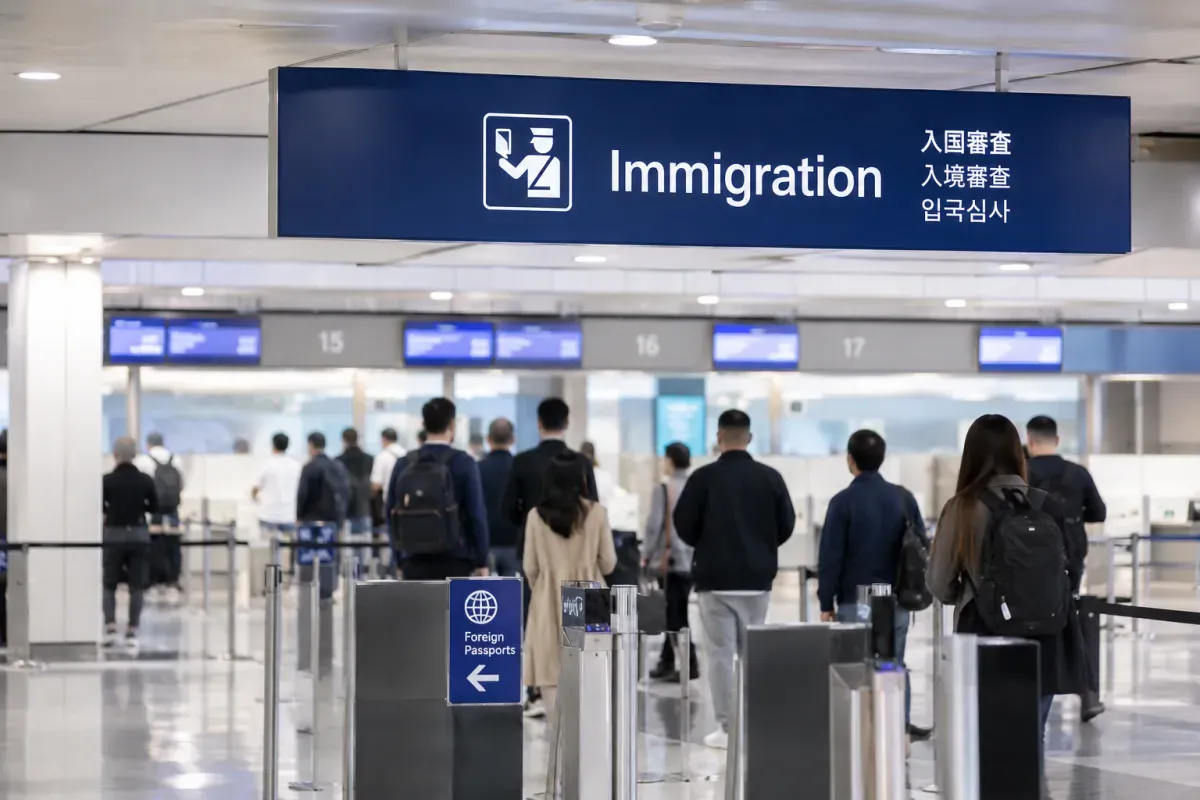
Most travellers arrive at Kuwait International Airport (KWI). At immigration you present your passport and visa (or eVisa), and biometric data such as fingerprints and a photo may be taken. If you obtained an eVisa in advance, have a copy ready. Have your travel documents and accommodation details to hand and follow the signage on arrival.
- Airport
- Kuwait Intl (KWI)
- Checks
- Passport + visa
- Biometrics
- Fingerprints/photo
- Have your eVisa copy ready at immigration
- Biometric data may be collected on arrival
Tips for Smooth Entry
Practical advice for a hassle-free arrival
Kuwait is very hot in summer, so bring light, modest clothing and stay hydrated. Dress conservatively, especially in public and religious places. Alcohol is banned, and public behaviour and photography of government or military sites are sensitive. Arabic is the official language but English is widely used. The country code is +965, the emergency number is 112, electricity is 240V with Type G plugs, and traffic drives on the right.
- Climate
- Very hot summers
- Dress
- Modest/conservative
- Basics
- +965 / 112 / 240V Type G
- Summers are extremely hot; dress modestly and stay hydrated
- Alcohol is banned; avoid photographing sensitive sites